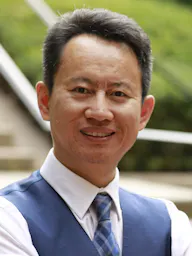
Xiaoming Zhai, Ph.D.
Areas of Expertise
- Science education with a focus on physics
- Assessment and measurement theory
- Applied quantitative methods and data sciences in science education
- Technology integration theory in science education
Interests
- AI/Machine learning-based innovative assessment practices in science
- Learning progression
- Mobile learning in science
- Science teacher education and career motivation
Concentrations
Education
- Ph.D. in Curriculum and Instruction (physics), 2017
Beijing Normal University
Contact
Research Summary
Dr. Xiaoming Zhai has built his career at the intersection of artificial intelligence (AI), innovative assessment, and science education, working to bring these fields into productive alignment so teachers can help every learner engage in ambitious STEM+C practices. At the University of Georgia, he is Professor of Science Education and AI, with courtesy appointments in the School of Computing and the Department of Statistics, and he directs both the AI4STEM Education Center (ai4stem.uga.edu) and the National Center on Generative AI for Uplifting STEM+C Education (GENIUS; ai4genius.org)—a $10M IES-funded center. These cross-campus platforms convene researchers from the College of Education, Franklin College of Arts and Sciences, and the College of Engineering to design AI-enabled solutions for STEM learning, producing turnkey analytics pipelines for NGSS-aligned performance assessments, professional learning modules for AI-supported instruction, and open-source tools that districts now use to diagnose students’ scientific argumentation, modeling, and data-use skills. His recent research centers on how to integrate AI into discipline learning, advancing students’ Discipline-based AI literacy (DAIL).
Zhai’s prominent scholarship made him the leading global voice on AI in STEM Education. His research bridges measurement theory, the learning sciences, and AI. He has published widely in flagship education journals—including the Journal of Research in Science Teaching, Studies in Science Education, International Journal of Science Education, Journal of Science Education and Technology, Research in Science Education, Computers & Education, and Computers & Education: Artificial Intelligence—demonstrating how natural-language processing, computer vision, latent-class analysis, and generative AI can automate multi-dimensional assessments and facilitate STEM teaching and learning. Distinctively for a science-education scholar, his technical work also reaches the premier venues of the AI and machine-learning communities, with contributions to NeurIPS, ICLR, AAAI/EAAI, the AAAI/ACM Conference on AI, Ethics, and Society (AIES), the ACL family of NLP conferences, the International Conference on Artificial Intelligence in Education (AIED), and the International Conference on Educational Data Mining (EDM). His work on ML-based scoring frameworks (e.g., Zhai et al., 2020, 2021) has become a reference point for projects seeking to capture three-dimensional science learning at scale. These contributions have earned major recognition, including the NAEd/Spencer Research Development Award (2021), AERA’s TACTL Early Career Scholar Award (2021), the Jhumki Basu Scholar Award from NARST (2020), a Humboldt Research Fellowship and Visiting Professorship at Germany’s Leibniz Institute for Science and Mathematics Education, and UGA’s Sarah Moss Fellowship. Across his career he has secured more than $18.9 million in external funding as PI or co-PI.
Zhai has also emerged as a leading voice shaping how the nation governs AI in education, translating research into policy guidance for federal and state agencies. Because AI’s impact depends on supportive policy, Zhai also translates research into guidance for agencies and states. He leads the NSF-funded Advancing AI in Science Education (AASE) initiative, serves on the Southern Regional Education Board’s AI in Education Taskforce and Advisory Panel, and co-chairs NARST’s AI Policy Task Force. Through these roles he coordinates cross-sector recommendations on data governance, educator preparation, and procurement standards, helping federal and state partners craft responsible AI strategies that reflect what the field knows about learning—and what it still needs to study.
Beyond research and policy, Zhai invests heavily in building scholarly community. He co-founded and chairs NARST’s RAISE (Research in AI-involved Science Education) interest group, co-chaired NARST’s Strand 1 on science learning, and serves on the editorial boards of the Journal of Research in Science Teaching, Journal of Science Education and Technology, and Disciplinary and Interdisciplinary Science Education Research, alongside guest-editing special issues. He edited Uses of Artificial Intelligence in STEM Education (Oxford University Press, 2024), Artificial Intelligence in STEM Education Research (Springer, 2026), Advances of AI in Science Education (Springer, 2026), and is the editor of Cambridge University Press’s incoming Handbook of AI in Education series. He founded and chaired the NSF-funded AI in STEM Education conference series (2022, 2024) and an AERA-sponsored international summit (2025), creating global forums where educators, computer scientists, and psychometricians co-design responsible AI applications—work amplified by his keynote addresses at international conferences across Asia and Europe.
Through externally funded projects, Zhai mentors cross-institutional teams that translate AI research into classroom-ready tools, while supervising postdocs, doctoral students, and visiting scholars who extend this work worldwide. His overarching contribution is demonstrating that AI—when grounded in learning theory, measurement rigor, and equity commitments—can be an engine for richer assessments, more responsive instruction, and inclusive participation across STEM disciplines.
Grants
Publications
Awards and Accolades
University of Georgia, 2022
The Alexander von Humboldt Foundation, 2022
University of Georgia, 2022
University of Georgia, 2021
University of Georgia, 2021
National Academy of Education, 2021
American Educational Research Association, 2021
National Association of Research in Science Teaching, 2020